.png) Balance Claims
Balance Claims
Do It Right: Why Reputation Is a Roofing Contractor's Greatest Competitive Advantage
.png?width=30&name=B%20(1).png) Balance Claims : Jul 3, 2026, 9:00:00 AM
Balance Claims : Jul 3, 2026, 9:00:00 AM
One of the biggest operational bottlenecks for growing roofing companies is supplementing.
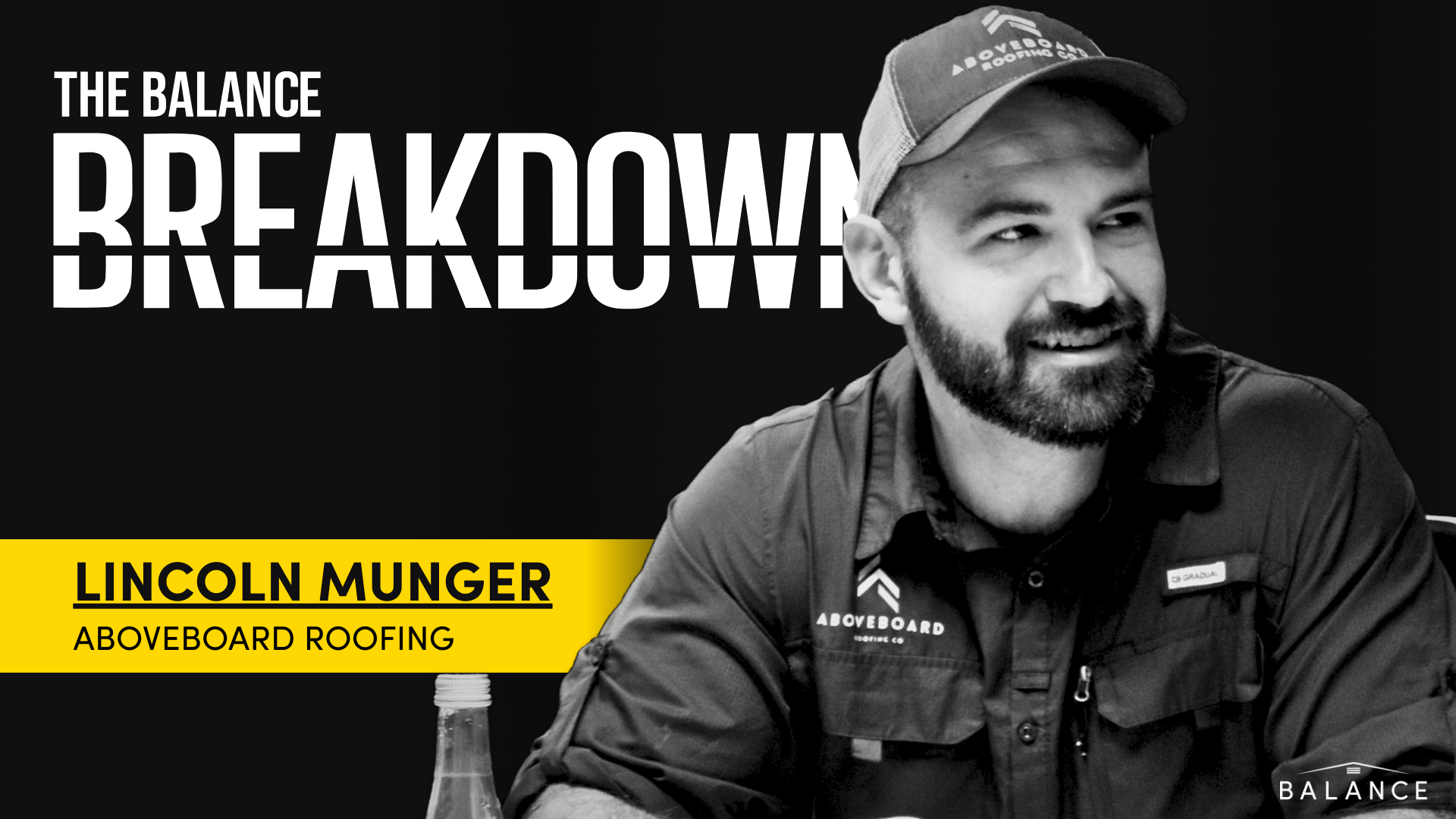
That was a major theme during a recent episode of The Balance Breakdown, where Aboveboard Roofing founder Lincoln Munger shared how he went from learning supplements on his own to building scalable systems designed to support rapid growth.
Like many contractors, Munger entered roofing through sales. But once production volume increased, he quickly realized that selling roofs and properly managing insurance claims are two entirely different skill sets.
The company he worked for at the time didn’t have dedicated supplement support, which meant he had to teach himself while still trying to produce at a high level in sales.
Instead of formal training, he reverse-engineered the process. He compared adjuster estimates, studied measurement reports, reviewed other contractors’ supplements, and combed through Facebook groups where experienced industry professionals shared Xactimate files and documentation.
That trial-and-error approach taught him an important lesson many growing contractors eventually discover: you cannot scale efficiently if sales reps are reinventing the supplement process on every single job.
Today, Munger still enjoys handling highly technical claims himself, especially unusual or specialty projects. During the interview, he described working on a geodesic roof with 78 slopes and 14 custom skylights, exactly the kind of complex project most contractors avoid.
But for normal operations, the focus shifted toward systems, workflows, macros, and consistency.
“The biggest change? Macros,” he said.
That evolution mirrors what many roofing companies experience as they grow. Early on, hustle can cover operational gaps. Eventually, systems become the difference between sustainable growth and constant chaos.
One of the most practical parts of the conversation centered around CRMs and operational infrastructure.
Munger started Aboveboard Roofing with growth in mind from day one. He wanted scalable systems before he even had a large team. Initially, he chose AccuLynx after researching options and hearing strong feedback from contractors online.
But what stood out most was his perspective on implementation.
“Anybody can use a CRM,” he said. “Building a CRM, that’s a business owner skill.”
That distinction matters more than most contractors realize.
Many companies buy software expecting it to solve operational problems automatically. In reality, the software only amplifies the processes already in place. Contractors with weak workflows simply create digital versions of their existing problems.
Munger emphasized that the real value comes from how the CRM is structured and automated. Integrations, workflows, clean documentation, task automation, and accountability systems are what create scalability, not the logo on the software.
He also stressed that automation becomes non-negotiable as companies grow.
“You’re not doing more than 10 million without automation,” he said.
That’s a reality many contractors discover the hard way during heavy storm years when volume overwhelms manual processes.
One of the more interesting parts of the interview was how Aboveboard Roofing evolved during a major storm cycle.
A March hailstorm in Louisville created immediate demand.
Munger described knocking doors while literally kicking hailstones away from homeowners’ entryways so they could open the door safely.
That surge created rapid growth opportunities. The company expanded quickly by hiring additional office support, adding management roles, and building more operational infrastructure.
But once storm volume slowed, Aboveboard Roofing faced a challenge many contractors encounter after explosive growth: how do you sustain the overhead once storm leads dry up?
The answer was diversification.
Instead of relying entirely on insurance restoration work, the company began expanding its retail sales process, financing options, and premium upgrade packages.
Munger discussed moving beyond simply selling “a roof” and instead building value into every project. That included impact-resistant shingles, upgraded ventilation systems, enhanced underlayments, extended warranties, and financing solutions that gave homeowners more flexibility.
“We’re actually building value,” he explained.
That shift reflects a broader trend happening across the roofing industry. Contractors who rely entirely on insurance-funded replacement work often struggle when claim approvals tighten or storm volume slows. Companies with strong retail systems tend to stay healthier long term because they are not dependent on a single revenue source.
Most roofing companies slow dramatically during winter. Munger treated winter as a problem to solve instead.
After learning from a Canadian roofer how crews install roofs in freezing climates, Aboveboard Roofing developed what he calls the “Canadian install.”
The process involved removing snow from roofs, heating shingles before installation, and carefully managing substrate temperatures to maintain proper adhesion during cold-weather installs.
The result was year-round production capability instead of a seasonal shutdown.
That willingness to experiment is one of the clearest themes throughout the interview. Munger consistently looks for operational advantages that most contractors ignore.
Sometimes innovation isn’t flashy technology. Sometimes it’s simply refusing to accept industry limitations as permanent.
As storm activity ramps up again, Munger’s focus is on balancing insurance restoration work with retail roofing systems.
His sales teams are trained to slow the process down, educate homeowners thoroughly, identify supplement opportunities, and present multiple solutions instead of rushing through a standard sales pitch. That includes discussing financing options, upgrade packages, and even local rebate programs homeowners may qualify for.
One example he shared was a local sustainability grant that provides qualifying homeowners with $2,000 toward white roofing systems.
That combination of technical expertise, process development, and homeowner education creates a much stronger sales position than simply competing on price.
Near the end of the episode, Munger shared the biggest piece of advice he would give contractors starting or scaling a roofing business: get your contracts right.
He emphasized that clear contracts protect both the contractor and the homeowner by eliminating gray areas and setting expectations upfront.
For contractors focused on growth, that mindset applies far beyond contracts.
Clear expectations. Clear systems. Clear documentation. Clear processes.
Storm season exposes weaknesses fast. The companies that scale successfully are usually the ones that build operational clarity before chaos arrives.
And that may be the biggest takeaway from this conversation.
As your sales volume grows, supplementing can quickly become a bottleneck. Missed line items, delayed approvals, and inconsistent documentation can slow down production and create unnecessary stress for your team.
Balance Claims helps roofing contractors streamline the supplement process so sales reps can stay focused on selling while claims are professionally managed behind the scenes.
From detailed supplement writing to carrier communication and CRM integration support, Balance helps contractors recover more claim revenue, improve turnaround times, reduce operational overload, and scale more confidently during storm season.
Whether you’re building systems for the first time or tightening operations before the next hail event, Balance gives your team the support structure needed to grow efficiently.
.jpg?width=500&height=500&name=Balance%20Social%20Media%20Content%20(10).jpg)
New episodes of The Balance Breakdown come out the first Friday of every month. Fill out the form below and we'll send you the link the show as soon as it drops.
Balance Claims : Jul 3, 2026, 9:00:00 AM
Balance Claims : Apr 27, 2026, 11:28:00 AM

3 Reasons To Attend The American Contractor Summit Jan 14-15 If you are a roofing contractor, you know there is no shortage of training events when...